The short answer
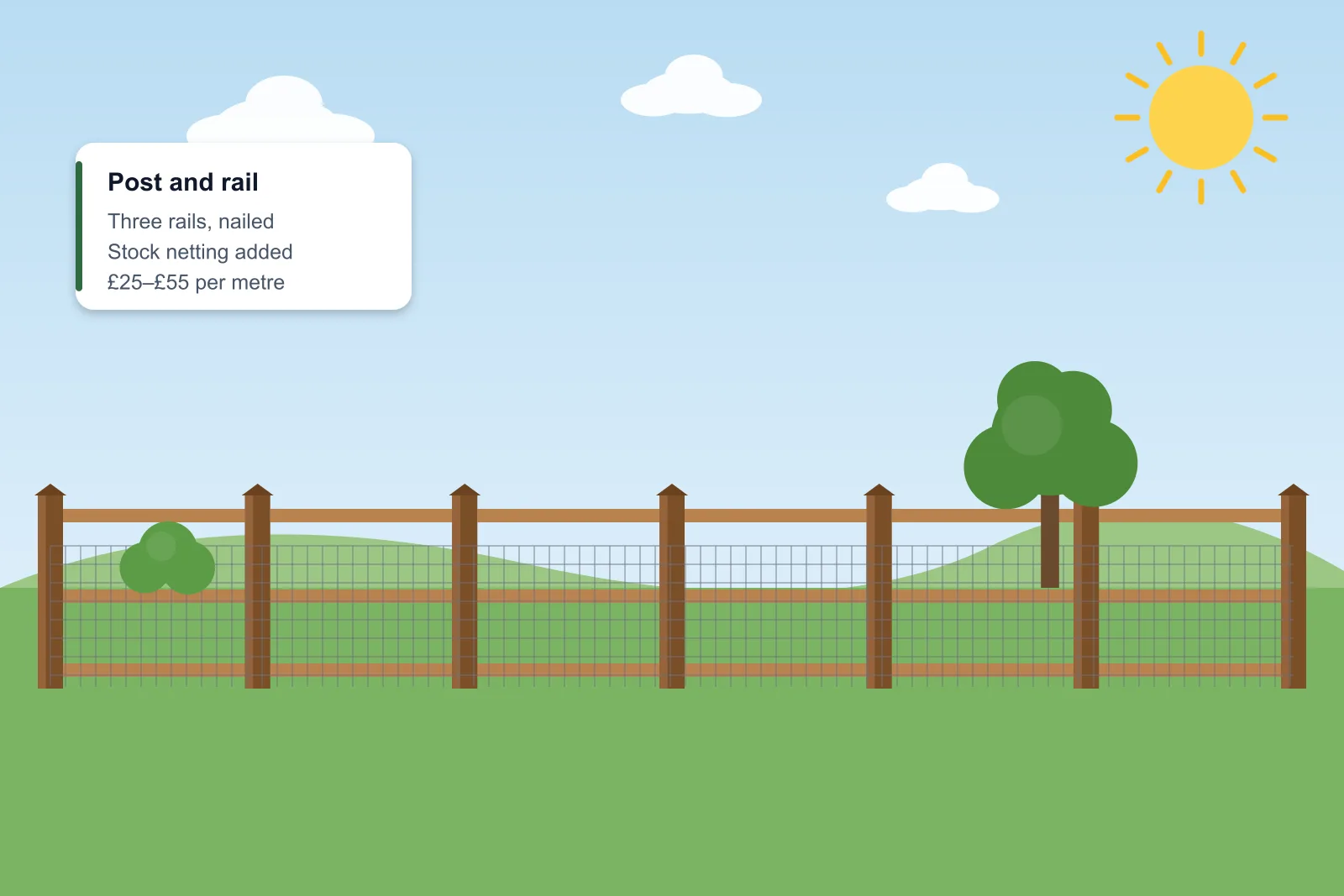
Post and rail fencing uses timber posts with two to four horizontal rails between them. It's open, so it gives no privacy, but it's strong, simple and affordable – typically £25–£55 per metre supplied and fitted, or £35–£70 per metre with stock netting added for dogs, sheep or other animals.
If you've driven through the countryside, you'll have seen post and rail fencing around fields and paddocks. It's also used in larger gardens, along driveways, to mark the front of a property, or to protect planting without hiding it. It works well alongside a hedge, giving immediate structure while the hedge grows.
There are two main types: nailed rails, where the rails are fixed to the face of the posts, and mortise rails, where the rails slot through holes cut in the posts.
Nailed vs mortise post and rail
Nailed post and rail is quicker and cheaper. Rails are nailed or screwed to the face of round or square posts, with joints staggered for strength. It's the most common type for paddocks and gardens.
Mortise post and rail is more traditional and looks neater. Rails have tapered ends that fit into slots in the posts. It's stronger and there are no nails to work loose, but it costs more and is harder to adapt to slopes.
- Two rails – for low boundaries, garden edges and driveways
- Three rails – standard for paddocks and most rural boundaries
- Four rails – for horses, higher boundaries or added strength
- Half-round or sawn rails – half-round is cheaper, sawn looks neater
Adding mesh for pets and livestock
On its own, post and rail won't keep dogs, rabbits or sheep in or out. Adding stock netting or welded mesh to one side turns it into a secure barrier. Rabbit netting needs to be buried 150–300mm into the ground and turned outwards. For dogs, see our dog-proof fencing guide. For horses, the mesh should be horse-safe with small apertures so hooves can't get caught.
For more on mesh options, see chain link and mesh fencing.
Posts and installation
Posts are usually pressure-treated softwood, round or square, typically 1.8–2.1m long for a three-rail fence about 1.1–1.2m high. On farms and paddocks, posts are often driven into the ground by machine rather than concreted, which is faster and very solid in the right soil. In gardens, posts are usually dug and concreted or backfilled with compacted hardcore.
Posts are typically spaced at 1.8m or 2.4m, depending on rail lengths. Straining posts at corners and ends take the tension if netting is added.
Lifespan and upkeep
Good pressure-treated post and rail typically lasts 15–20 years, longer with hardwood posts. The posts at ground level are the weak point – see how to stop fence posts rotting. Check for loose rails each spring, especially where animals lean on them.