The short answer
Chain link fencing typically costs £20–£45 per metre supplied and fitted at 1.2–1.8m high. Rigid welded mesh panels cost more – around £45–£90 per metre – but are stronger, neater and more secure. Mesh is ideal where you want a boundary without blocking light or views, and it can be softened with climbing plants or hedging.
Mesh fences are everywhere – around schools, sports pitches and car parks – but they're just as useful in gardens. They're cheaper than solid fencing, last a long time, and don't catch the wind. On a long boundary, behind a hedge or around a vegetable plot, they can make a lot of sense.
There are three main types, and they're not interchangeable.
The three main types
Chain link
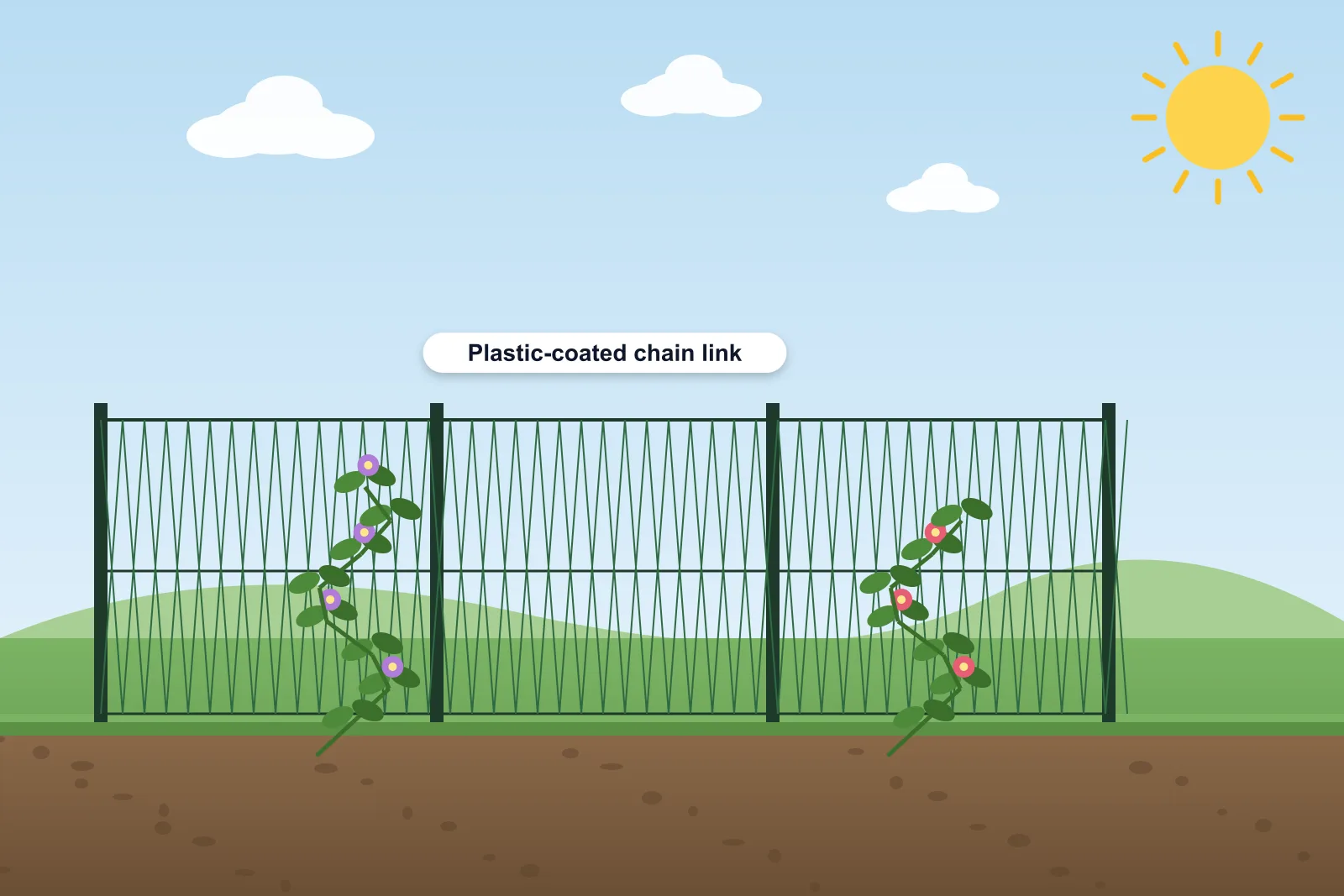
Woven diamond-pattern wire, supplied in rolls and tensioned between posts using line wires. It's cheap, flexible and follows uneven ground well. Plastic-coated green or black chain link is the norm in gardens; galvanised is more industrial. Over time it can sag if not tensioned properly.
Welded mesh rolls
Square or rectangular mesh with welded joints, often used on post and rail fences or for rabbit, chicken and dog runs. It's stiffer than chain link and comes in many mesh sizes and gauges.
Rigid mesh panels
Welded mesh in stiff, flat panels – often with a V-shaped fold for strength – bolted to steel posts. It looks neat and modern, is very strong, and is widely used for security and around schools. Twin-wire (or 'double wire') panels are stronger still.
Where mesh fencing works well
For dogs, mesh size and height matter more than the fence type. See dog-proof fencing. For a natural look, see hedge vs fence.
- Long rural or garden boundaries on a budget
- Behind a new hedge, until the hedge fills out
- Keeping dogs and children in without blocking the view
- Vegetable plots, chicken runs and play areas
- Boundaries where you want climbing plants to grow
- Security around outbuildings and side passages
Adding privacy
Mesh gives no privacy on its own. Options include slatted inserts that weave through the mesh, screening rolls of willow, reed or bamboo attached to the face, or climbing plants such as ivy, clematis or jasmine. Each one adds wind load, so posts must be strong enough. See bamboo and willow screening.
Posts and fixings
Chain link is usually fixed to steel or concrete posts with straining posts at the ends and corners, where the tension is taken. Timber posts can be used in gardens. Rigid panels use steel posts with clamps or brackets. All posts should be concreted in – see how deep fence posts should be.