The short answer
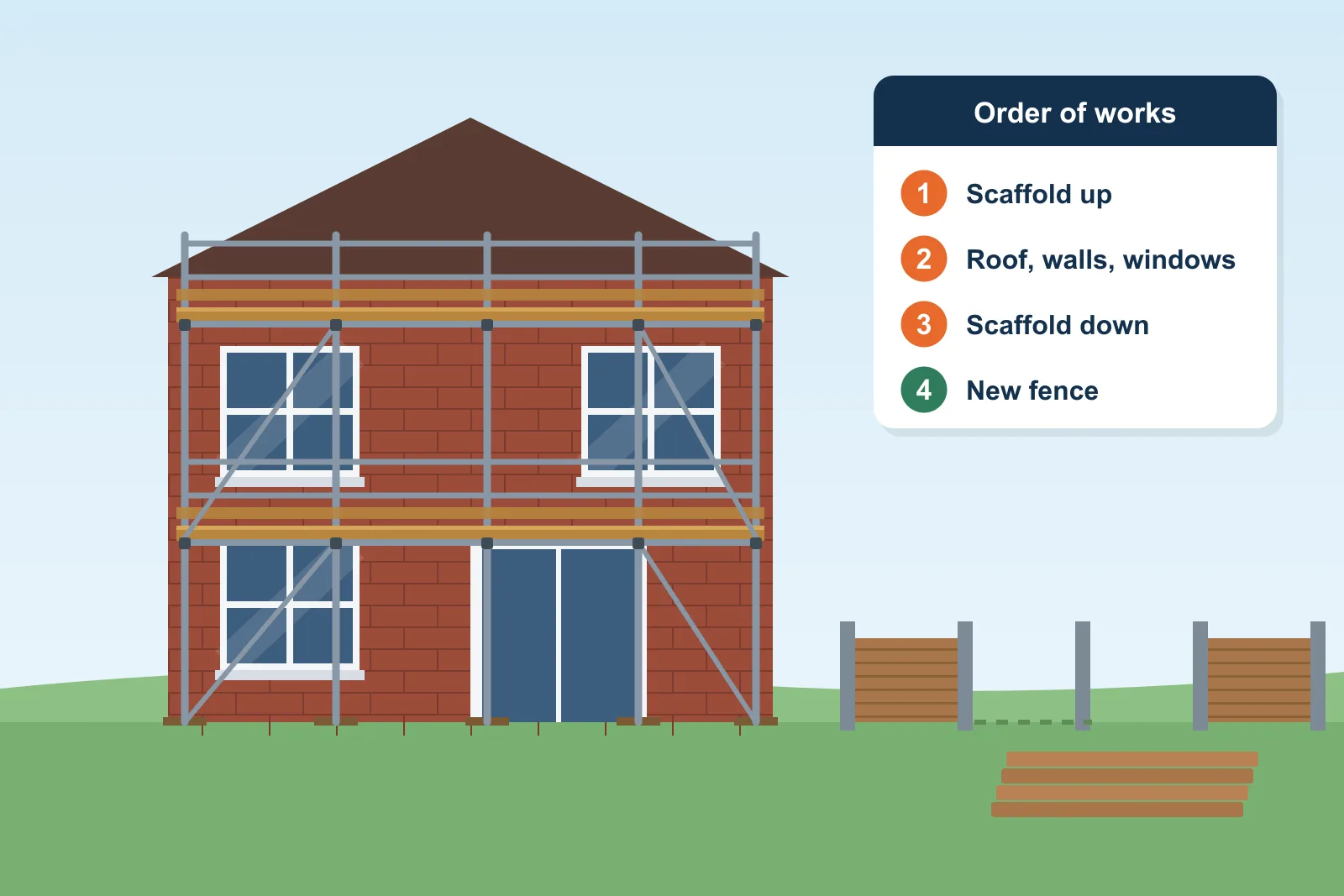
You'll usually need scaffolding for any significant exterior work above ground-floor level, such as roof repairs, chimney work, rendering, fascias, gutters, upstairs windows and wall insulation. A typical house scaffold stands around a metre to a metre and a half out from the wall, so plan for it before new fencing, paving or planting go in, and put the new fence up last.
An exterior renovation has a habit of growing. A few slipped tiles become a new roof, tired fascias become new fascias, gutters and downpipes, and while the scaffolding is up it seems sensible to re-render or replace the windows too. Somewhere in the plan there's usually a garden project as well: a new fence, a patio or a side gate.
The order you tackle these jobs in matters more than most people expect. Scaffolding needs firm ground, space along the walls and sometimes access across a boundary, and it can easily damage a new fence or lawn if it arrives afterwards. This guide explains which jobs usually need a scaffold, how it affects your garden and boundaries, and how to sequence the work so nothing has to be done twice.
Exterior jobs that usually need scaffolding
The Work at Height Regulations expect the safest practical access to be used for each job. For quick, low-level tasks a ladder can be acceptable, but most substantial work above ground-floor level is done from a scaffold or a tower. Jobs that commonly need one include:
- Re-roofing, roof repairs and chimney work
- Replacing fascias, soffits, gutters and downpipes
- Rendering, repointing or external wall insulation
- Replacing upstairs windows, especially larger units
- Exterior painting of upper walls and woodwork
- Loft conversions and new dormer windows
- Fitting high-level lights, cameras or aerials
Tower or full scaffold?
A mobile aluminium tower is a good choice for short, contained jobs: a single gutter joint, one window frame or a few square metres of brickwork. It's quick to put up and move, but it needs firm, level ground and room for its outriggers, which isn't always available on a sloping garden or a narrow side path.
Full scaffolding suits bigger or longer projects, high walls and anything involving the roof. It gives a continuous, guarded platform along the whole wall, can carry materials and stays put for weeks if needed. For a whole-house exterior renovation it's almost always the right choice, and a domestic scaffolding specialist can design it around your house, your garden and the trades who will be using it.
How much garden space does a scaffold need?
A standard independent scaffold on a house stands roughly a metre to a metre and a half out from the wall, on base plates and timber sole boards that spread the load. Add room for the scaffolders to work and for tubes and boards to be stacked, and you need a clear strip of about two metres along each wall while it's going up.
In a back garden that strip often takes in flower beds, a patio edge, a shed or the boundary fence. On a semi or a terrace, a side or rear wall may be close enough to the boundary that the scaffold has to stand partly on a neighbour's land, or a fence panel has to come out to make room.
Lawns and soft ground
Sole boards spread the weight, but they still mark grass and compact the soil, especially in wet weather. Expect to reseed or returf the strip once the scaffold has gone, and don't lay new turf before it comes down.
Sloping gardens
Scaffolds can be built on slopes, steps and uneven ground, but they take longer to design and erect. Tell the scaffolding company about changes in level when you ask for a quote so the price reflects the real job.
Side returns and narrow paths
Where there's less than a metre between the house wall and the boundary, a standard scaffold may not fit. The scaffolder might use a narrower design, build from the neighbour's side with permission, or ask for a fence section to be taken out temporarily.
Scaffolding and your fence
Fences and scaffolds don't mix well. Fence panels are light and easily knocked, and putting a scaffold up or taking it down involves long tubes and boards being passed through tight spaces. If you're planning a new fence, the simplest rule is to install it after the scaffold has gone.
If the existing fence is staying, ask whether any panels need to come out for access. It's often easier to lift out a panel between two posts, store it flat and refit it afterwards than to work around it. Agree in advance who will do this and who is responsible for any damage. On a shared boundary, tell your neighbour too, because a missing panel affects their privacy and security, and possibly their dog's escape route.
Concrete posts and gravel boards usually survive scaffolding well; timber panels and trellis are more vulnerable. Many scaffolding firms will sheet or board over a fragile fence line if you ask before they start.
The best order of works
For a project that combines roof, wall and garden work, this sequence avoids most of the clashes:
- Survey and quotes, including scaffold design and any licence or neighbour permissions
- Clear fence panels, garden furniture and pots from the scaffold area
- Scaffold erected, inspected and handed over
- Roof, chimney, fascias and gutters first, working from the top down
- Walls, windows, render and any exterior painting
- Scaffold taken down and the garden cleared
- Groundworks: new paving, paths and drainage
- New fence, gates and trellis
- Lawn repairs and planting last
Neighbours, boundaries and permissions
If the scaffold needs to stand on, or overhang, a neighbour's land, you need their permission before it goes up. Explain what's involved, how long it's likely to stay and how you'll protect their garden. Most people are reasonable when they're asked early and the scaffold is tidy and secure.
Where the scaffold stands on the pavement or road at the front, the scaffolding company will apply to the council for a licence, which can take a couple of weeks. Scaffolding alone doesn't normally bring the Party Wall etc. Act 1996 into play, but if the work itself involves a shared wall in England or Wales, it may apply.
It's also a good moment to confirm where your boundaries actually are. If the fence is being replaced after the work, check which side of the fence is yours before the scaffold goes up, so posts aren't disturbed or moved by mistake.
Keeping the house and garden secure
A scaffold gives easy access to upstairs windows, and a missing fence panel opens up the garden. Ask the scaffolding company to remove or board off the bottom ladder at the end of each day, consider a scaffold alarm for longer jobs and keep side gates locked. If you've taken a fence panel out, a temporary mesh panel or a sheet of OSB screwed between the posts is a cheap way to keep the boundary closed until the work is finished.
Final thoughts
Scaffolding is part of almost every serious exterior renovation, so plan for it from the start rather than treating it as an afterthought. Work out where it will stand, what in the garden it affects and who needs to agree to it. Do the high work first, let the scaffold come down, then finish with the paving, fence and planting. That way the last thing to go in is also the first thing visitors see, and it hasn't been scratched by a scaffold tube.