The short answer
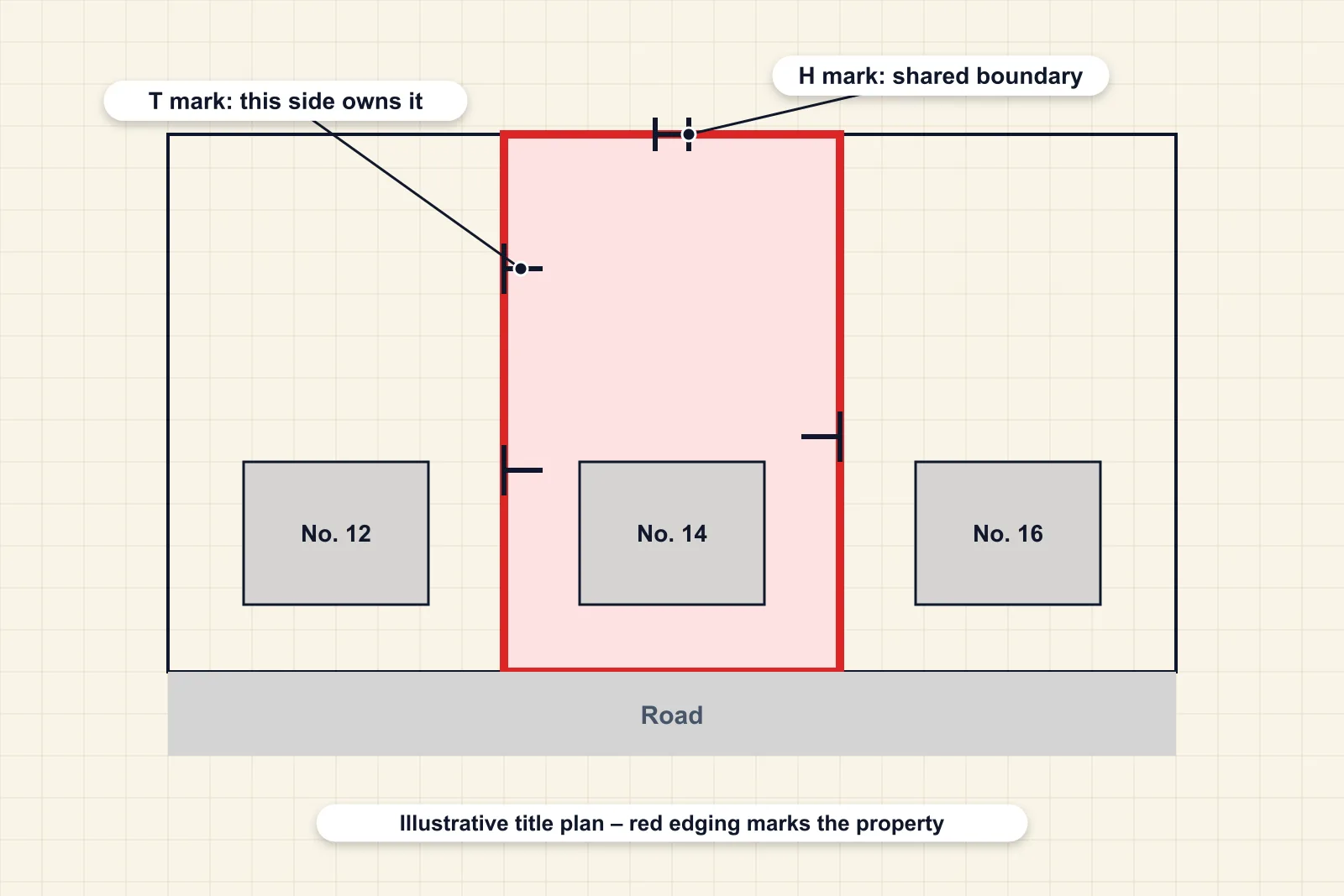
Check your title deeds and the title plan from HM Land Registry. A “T” mark on the plan or in the conveyance shows the boundary belongs to the property on the side of the T, and an “H” mark shows a shared (party) boundary. There is no general rule that the left-hand or right-hand fence is yours. If the documents are silent, ownership is often agreed between neighbours.
Questions about who owns a fence come up most often when it needs replacing. Knowing whose responsibility it is avoids awkward conversations, wasted money and – occasionally – disputes that end up costing far more than the fence.
Unfortunately there is no single rule that applies everywhere. The answer is usually in your property documents, and sometimes it is not recorded at all.
Where to look
Land Registry title plans show “general boundaries” – they indicate roughly where the boundary is but not its exact line, and they often do not show who owns the fence. Older conveyances are more likely to contain covenants such as an obligation to “erect and maintain” a particular boundary.
- Your title deeds and the original conveyance or transfer from when the house was first sold
- The title register and title plan, available from HM Land Registry for a small fee
- Any boundary agreements, or answers given in property information forms when you bought
- The developer's plans, for newer estates

T marks and H marks
A T mark drawn against a boundary on a plan indicates that the boundary belongs to – or must be maintained by – the property on whose side the T sits. An H mark (two Ts back to back) means the boundary is shared, and responsibility is usually split equally.
Not every plan has these marks, and where they exist they record what the original developer intended. Later agreements can change the position.
Common myths
There is no law that says the fence on the left (or right) is yours, and no law that says the owner must put the smooth side facing out. The position of the posts is a clue to who built the fence, but it does not prove ownership. In most cases there is also no legal duty to have a fence at all, unless your deeds require one or you keep livestock.
If you cannot establish ownership, the practical answer is usually to agree with your neighbour: share the cost of a replacement, or let one of you take on the boundary and put the arrangement in writing.