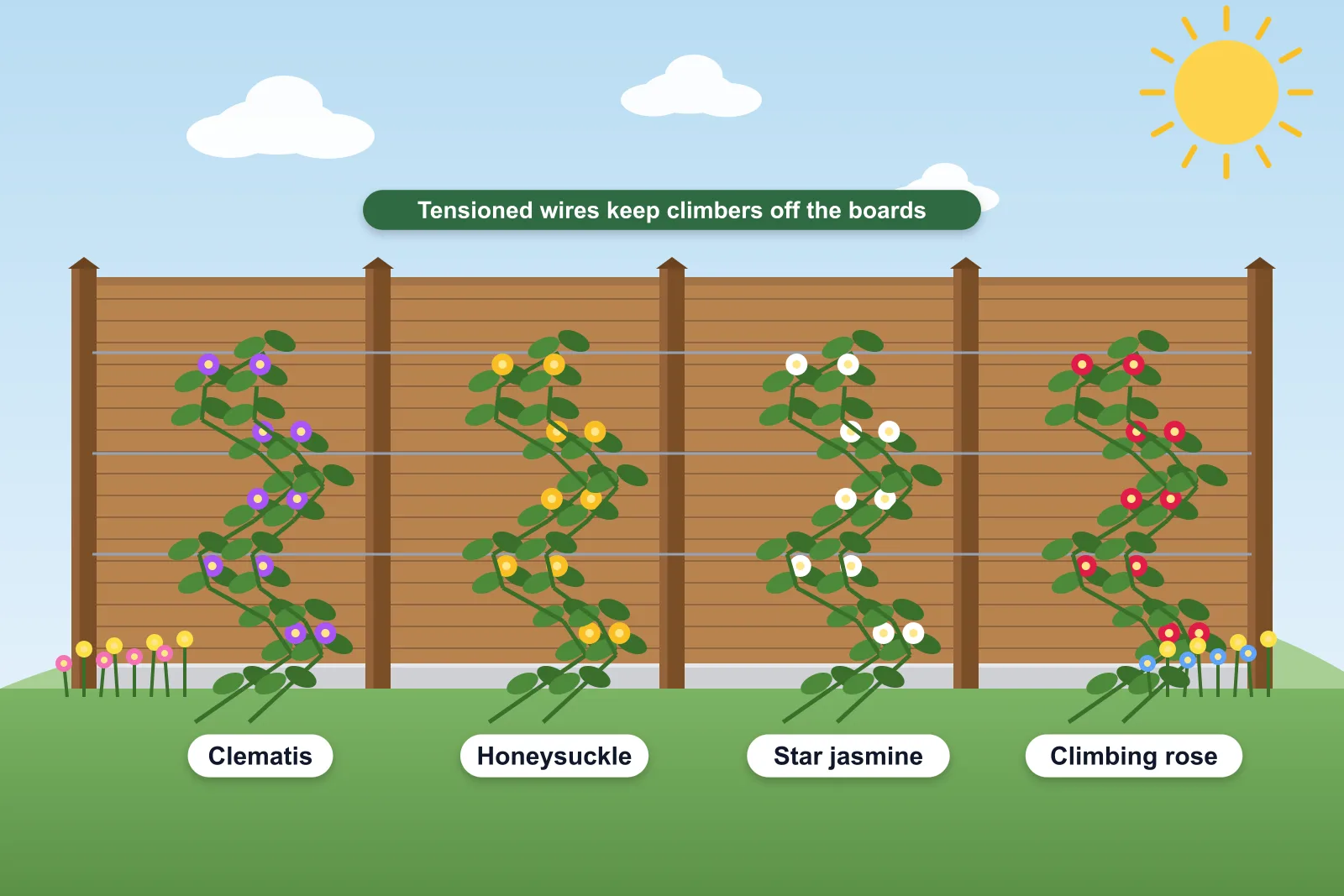
The short answer
Good climbers for fences include star jasmine and evergreen clematis for year-round cover, honeysuckle and summer-flowering clematis for scent and colour, climbing roses for sunny fences and climbing hydrangea for shade. Grow them on tensioned wires or trellis fixed to the posts, so air can circulate and the fence can still be maintained.
Plants make a fence part of the garden rather than a barrier around it. Climbers also add a layer of privacy above the fence line on trellis, give birds somewhere to nest and help to hide a fence that is past its best.
But some climbers are too heavy or too vigorous for a timber fence, and plants pressed against the boards keep them damp. Choosing well and giving them the right support avoids both problems.
Climbers that suit fences
Match the plant to the aspect. South and west-facing fences suit roses and jasmine; north and east-facing fences suit climbing hydrangea, some clematis and honeysuckle.
- Star jasmine (Trachelospermum) – evergreen, scented white flowers, likes sun
- Evergreen clematis such as Clematis armandii – early flowers and year-round leaves
- Summer-flowering clematis – huge range of colours, light and easy to manage
- Honeysuckle (Lonicera) – scented flowers loved by pollinators, tolerates part shade
- Climbing and rambling roses – best on sunny fences with strong wire support
- Climbing hydrangea – self-clinging, good for shady, north-facing fences
How to support climbers
The best support is a set of horizontal galvanised wires held on vine eyes screwed into the posts, about 30–45cm apart and spaced slightly off the face of the fence. Trellis panels fixed to the posts work well too. Both let air circulate behind the plants, so the boards dry out after rain.
Leave a gap between the plants and the boards where you can, and keep the base of the fence clear of soil and mulch. When the fence needs treating, untie the stems and lay them down carefully, or treat before planting.
Climbers to avoid on fences
If the fence belongs to your neighbour, ask before training plants onto it. Grow climbers on your own freestanding trellis or wires on your own posts instead.
- Wisteria – very heavy and strong enough to pull a fence apart
- Russian vine – extremely vigorous and smothers everything
- Ivy on a fence you want to keep – it holds moisture and works into joints
- Leylandii and other large shrubs planted tight to the boundary