The short answer
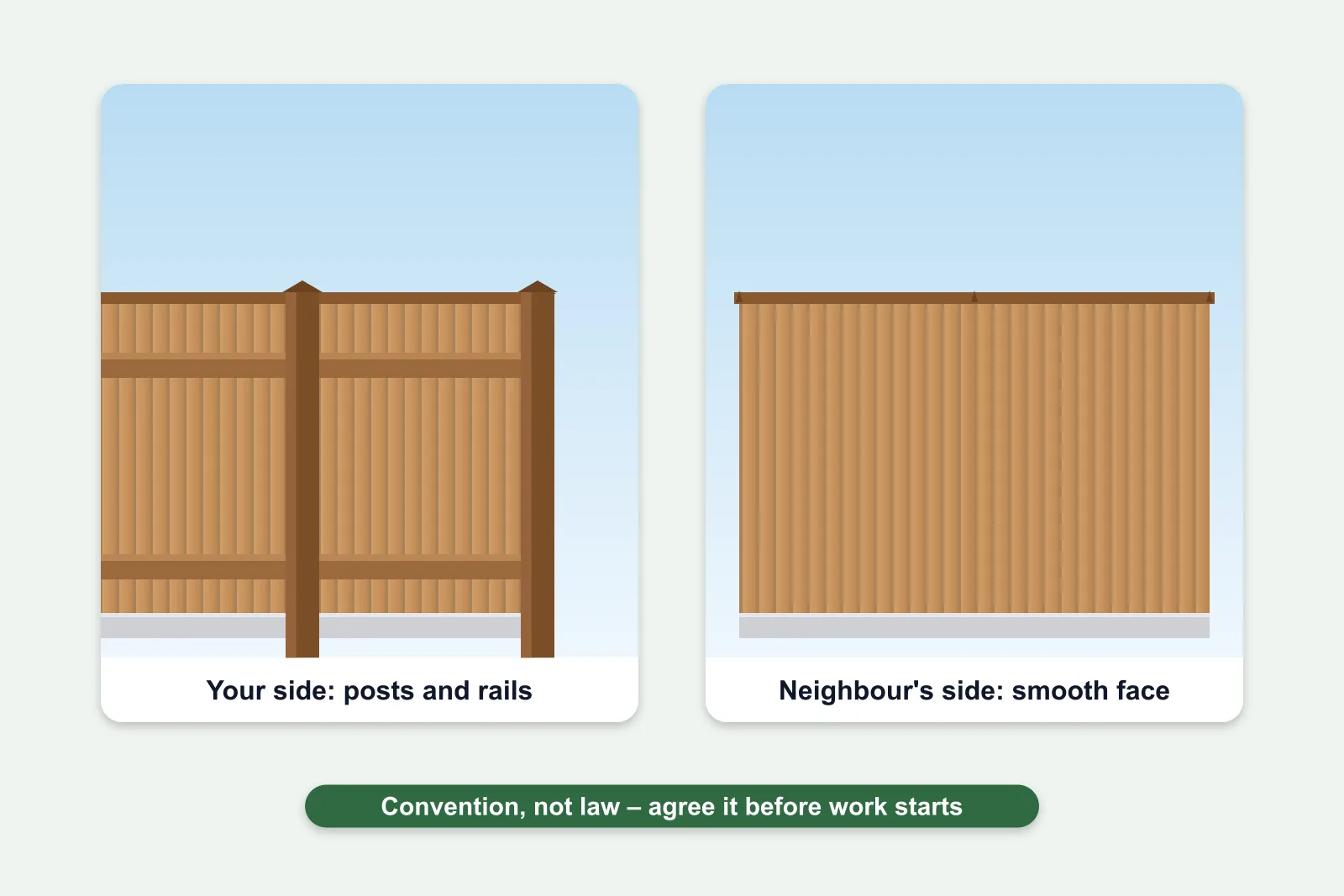
By convention, the “good” side – the smooth face without visible posts and rails – faces outwards towards the neighbour or the street, and the posts and rails sit on the owner's side. This is good manners rather than a legal requirement, unless your deeds or a planning condition say otherwise. If you want both sides to look good, choose a double-sided design such as hit-and-miss.
Every fence has a front and a back. On a closeboard or panel fence, one side shows the smooth boards and the other shows the posts, rails and framing. Most people would rather look at the smooth side, which is where the question comes from.
Here is where the convention comes from, what the law actually says and some ways to avoid the problem altogether.
The convention
Traditionally, whoever puts up the fence faces the finished side outwards – towards the neighbour, the road or the countryside – and keeps the structural side facing into their own garden. It is seen as the courteous choice, and many developers and contractors follow it as standard.
There is a practical logic too: with the posts on your side, the fence is built entirely on your land, and you can reach the posts and rails for maintenance.
What the law says
There is no general law requiring the good side to face your neighbour. Some older deeds include covenants about how a boundary should be built, and some planning conditions on new estates specify boundary treatments, so it is worth checking. Otherwise, it is your choice.
Ways to keep everyone happy
Concrete posts with panels slotted in the centre are often the easiest compromise: neither side sees exposed rails, and both sides get a tidy finish.
- Talk to your neighbour before the work starts and agree which way the fence will face
- Choose a double-sided fence – hit-and-miss or double-sided slatted – that looks the same from both sides
- Fit panels in the middle of slotted concrete posts, which look neat from either side
- If the neighbour wants the good side, offer to share the cost