The short answer
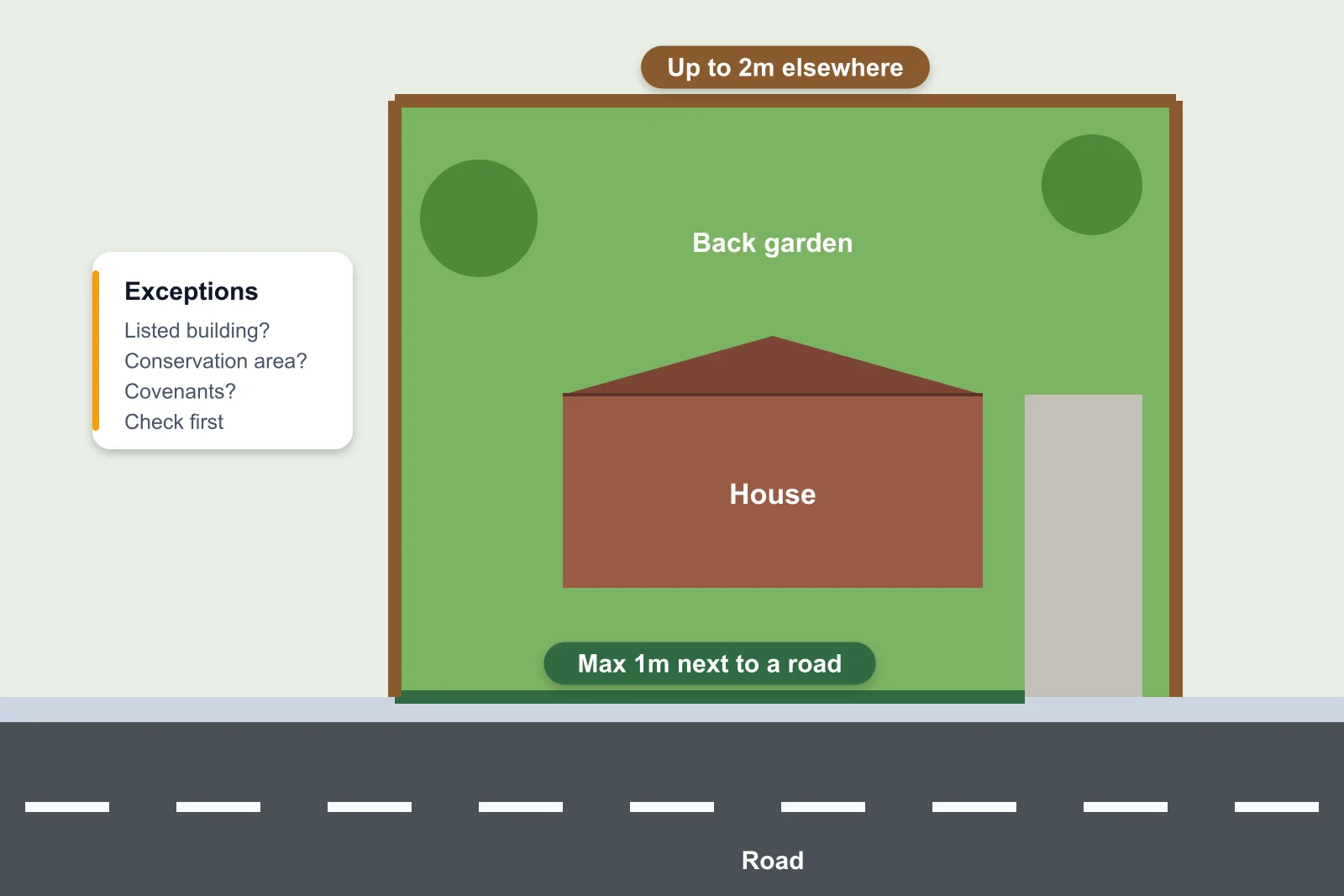
You do not normally need planning permission for a fence, wall or gate up to 2m high, or up to 1m high where it is next to a road used by vehicles (or the footpath beside it). You do need permission if the property is a listed building, if permitted development rights have been removed by an Article 4 direction or planning condition, or if the fence goes above those heights.
In planning terms, putting up a garden fence is usually “permitted development” – work that is automatically allowed without applying to the council, as long as it stays within certain limits. For fences, those limits are mainly about height and where the fence is.
The rules described here are for England. Wales, Scotland and Northern Ireland have broadly similar limits with some differences in detail, so check with your local planning authority if you are unsure.
The height limits
Height is generally measured from ground level. Where the ground is higher on one side of the boundary, or a fence is built on a raised bed or retaining wall, the measurement can be less straightforward – ask your council how they would measure it before you build.
- Up to 2m high – most back and side garden boundaries
- Up to 1m high – next to a highway used by vehicles, or the footpath of such a highway
- Trellis, finials and any wall the fence sits on all count towards the height
When you need permission anyway
Separately from planning, restrictive covenants in your deeds may forbid fences in front gardens or require a particular style. Covenants are a private legal matter rather than planning, but they can still be enforced.
- The house is a listed building, or the fence is within its curtilage
- An Article 4 direction removes permitted development rights in your area
- A planning condition on your estate restricts boundary treatments – common on open-plan estates
- The fence would form part of a new or altered access onto a road
If you need a taller fence
You can apply for householder planning permission for a fence above the permitted height. Councils consider the effect on neighbours, the street scene and road safety. A 2.4m fence between back gardens is often approved; a tall fence along a prominent front boundary is less likely to be.
If you put up a fence that breaks the rules, the council can ask you to apply retrospectively or take enforcement action requiring you to lower or remove it. It is far cheaper to check first.